
Provably Fair Casinos: Trust Models Compared
Provably Fair is one of three trust models in online gambling, alongside eCOGRA certification and blockchain-native verification. This guide compares all three, breaks down the cryptography behind SHA-256 commit-reveal, examines real implementations at Stake, BC.Game and BetFury, and provides working JavaScript verifier code you can run yourself. Verified operators are collected in top crypto casinos with Provably Fair.
 Author: Artem Kovalenko
 Reviewed by: Olexandr Tkachenko
How to verify a provably fair round in 5 minutes
Every top crypto casino with PF gives you tools to verify rounds. Step-by-step on the Stake example.
- Open round history in the casinoIn your account - Bets/History tab. Find the round you want to verify (number, time, bet, result).
- Copy server seed + client seed + nonceClick the round. The casino shows three params: server seed (revealed after the round), client seed (yours or generated), nonce (round index).
- Open the public verifierStake provides https://stake.com/provably-fair/calculation. BC.Game and Duel have similar pages in the Fairness section.
- Paste seeds and get the resultThe verifier recalculates hash → formula → result. If it matches the round - it is fair. If not - contact support.
- Change client seed for fresh roundsFor extra safety rotate your client seed each session - this guarantees the casino could not pre-compute future rounds.
What is a "provably fair predictor" and why it is a myth
SERPs are full of "provably fair predictor" queries - users look for a tool that forecasts crash multipliers. Here is how this actually works.
- Provably fair uses SHA-256 hash + a future server seed not yet revealed during the round. Mathematically impossible to predict.
- "Predictor" sites are either scams (fake results) or post-factum verifiers (showing already known results as a "forecast").
- The honest way to win at crash - bankroll management and auto-cashout at low multipliers, not "prediction".
Crypto casinos with provably fair: quick compare
Which online casinos run real provably fair, which games support it, where to find the verifier.
| Casino | PF games | Verifier URL | Open source |
|---|---|---|---|
| Stake | Crash, Plinko, Mines, Hilo, Dice, Limbo | stake.com/provably-fair | Yes |
| BC.Game | Crash, Plinko, Mines, Dice, Hash games | bc.game/fairness | Partial |
| Duel | Crash, Plinko, Dice, Coin Flip | duel.win/fair | Yes |
| BetFury | Crash, Plinko, Dice, Mines | betfury.com/fairness | Partial |
| Bitsler | Dice, Roulette, Crash | bitsler.com/fairness | Yes |



Three trust models in online gambling
Provably Fair, eCOGRA certification, blockchain-native verification
When you bet money online, something has to make you believe the casino is not cheating. There are three primary mechanisms. They protect different things, and modern crypto casinos increasingly use multiple at once.
Provably Fair
Casino publishes SHA-256 hash of round seed before the round. After the round, seed is revealed. Player verifies hash matches.
Protects:Individual round integrity. Math result of one specific bet.
Limits:Requires player action. Only works for native crypto games (not classic slots).
eCOGRA / GLI / iTech Labs
Independent auditor runs millions of test rounds, confirms RTP matches claimed value within statistical bounds. Casino displays certification.
Protects:Long-term return percentage. Game math doesn't favor casino more than stated.
Limits:Trust the auditor. Cannot verify individual rounds. Audit is periodic, not real-time.
Blockchain-native
Game runs as smart contract on Ethereum/Solana. Randomness via Chainlink VRF or block hash. Result is transaction on public blockchain.
Protects:Maximum transparency. Code is open-source. Random source is publicly verifiable.
Limits:Gas fees. Limited game types. Smart contract bugs are exploitable. Still niche in 2026.
The big realization: these three models are not competitors - they cover different attack surfaces. The best casinos combine them. BC.Game has Provably Fair for crash games + eCOGRA for partner slots + some blockchain-native games. Stake has Provably Fair for Originals + eCOGRA for partner content. The strongest setup wraps all three.
| Trust Model | Verifies | Player action | Real-time | Works for slots |
|---|---|---|---|---|
| Provably Fair | Single round | Required | Yes | No |
| eCOGRA certification | Average RTP | None | Periodic | Yes |
| Blockchain-native | Everything | Optional | Yes | Limited |
The cryptography behind Provably Fair
SHA-256, commit-reveal, and why it actually works
Provably Fair sits on top of one cryptographic primitive: SHA-256. Understanding why this primitive enables trustless verification clarifies why the system actually works.
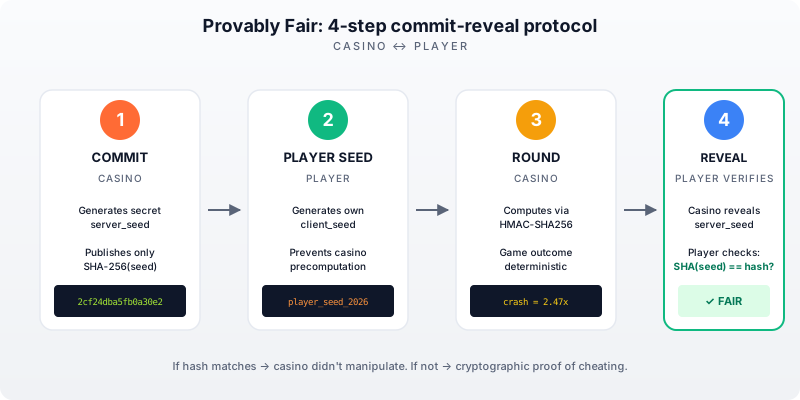
SHA-256 properties that matter:
1. Determinism. The same input always produces the same hash. SHA-256 of "hello" is always 2cf24dba5fb0a30e26e83b2ac5b9e29e1b161e5c1fa7425e73043362938b9824. No randomness in the function itself.
2. Avalanche effect. Changing one bit of input completely changes the output. SHA-256 of "hello" and "Hello" share no visible pattern. There's no way to incrementally adjust a hash by tweaking input.
3. One-wayness (preimage resistance). Given a hash, you cannot compute the input. The space is 2^256 possibilities - more than atoms in the observable universe. Even quantum computers face this brick wall.
These three properties enable the commit-reveal protocol:
Phase 1: Commit. Casino generates a random server seed S. Computes H = SHA-256(S). Publishes H to the player before any bet. The casino has now "committed" to S without revealing it.
Phase 2: Player participation. Player generates their own client seed C. This is critical - it prevents the casino from precomputing favorable outcomes. The result depends on both S and C combined.
Phase 3: Round execution. The round runs. Result is computed via HMAC-SHA256(S, C:nonce), where nonce is the round counter.
Phase 4: Reveal. Casino publishes the original server seed S. Player verifies:
(a) SHA-256(S) = H (the originally published hash). If not, casino changed S after committing - immediate proof of cheating.
(b) Re-running HMAC-SHA256(S, C:nonce) reproduces the round's result. If not, casino used a different formula than claimed.
If both checks pass, the round was provably fair - no possible manipulation by the casino after the original commitment.
Real implementations: 3 case studies
How Stake, BC.Game and BetFury implement Provably Fair
Stake Originals - in-house engine
- Built proprietary "Stake Engine" for Originals games (Crash, Mines, HiLo, Wheel, Slide, Limbo, Plinko)
- Open documentation at stake.com explaining exact algorithms per game
- Each game has its own formula (Crash uses HMAC-SHA256 + 13-char hex parse, Dice uses different threshold check)
- Built-in verifier in user account - paste seeds, get result instantly
- Forced server seed rotation after 1M rounds or on player request
BC.Game - hybrid (in-house + providers)
- Native games use BC.Game's own engine (similar to Stake's approach)
- Third-party games use provider algorithms (Spribe for Aviator, BGaming for Plinko, Smartsoft for JetX)
- Unified verification page across game types
- Open API to retrieve seed history programmatically (useful for power users)
- Server seed shown both before (hashed) and after (raw) rounds
BetFury - provider integration focus
- Heavily reliant on third-party providers (Spribe, BGaming, Hacksaw)
- Each game links to its provider's official verifier rather than in-house tool
- Faster game library expansion since not building algorithms in-house
- Limited Provably Fair on their own slot-like games
- Good for crash games and crypto-native titles, weaker for Originals-style content
JavaScript verifier code
Working code to verify Stake-style crash games in your browser
You can verify a Provably Fair round without trusting any casino tool. The full verifier fits in 30 lines of JavaScript and runs in any modern browser console.
Copy this into your browser console, replace the seeds with your actual data, hit Enter. The script computes both the expected hash commitment and the round result independently of the casino's verifier. If everything matches what the casino showed, the round was provably fair.
Different providers use different formulas. Aviator (Spribe), JetX (Smartsoft), and BGaming all have variations. Check each provider's documentation for the exact crash calculation - the commit-verify logic is universal, only the result formula differs.
Theoretical attack vectors
What could still go wrong, and how mitigations work
Provably Fair is mathematically sound, but real-world implementations have potential weak points. Understanding these helps you spot bad implementations.
History: from SatoshiDice to Aviator
12 years of Provably Fair evolution
2012 - SatoshiDice. The original Provably Fair casino, running directly on Bitcoin blockchain. Each bet was a Bitcoin transaction. The dice outcome was deterministic based on transaction data plus a publicly-committed casino secret. Crude but pioneering.
2014 - PrimeDice and BitcoinDice. Refined the model. Introduced client-side seed input from players (preventing precomputation attacks). Server seed rotation became standard. These sites also abandoned the "transaction = bet" model for performance, moving to off-chain Provably Fair.
2017 - Stake.com. First major casino to launch with Provably Fair as a core feature across all original games. Built a sophisticated in-house engine. Made the verification UI accessible to non-technical players. Set the modern standard.
2019 - Aviator launches. Spribe releases Aviator with full Provably Fair. The game becomes massively viral, taking Provably Fair from crypto niche to mainstream. Hundreds of casinos integrate it.
2021-2023 - Explosion of providers. BGaming, Smartsoft, Hacksaw and dozens of smaller providers launch Provably Fair game suites. Crash games dominate, but Plinko, Mines, Dice all see new entries.
2024-2026 - Maturity. Provably Fair is now table stakes for crypto casinos. Implementations standardize. Major casinos (BC.Game, Stake, BetFury) compete on UX of verification rather than presence of feature. New game types (slide, double-up) extend the model.
Future: zk-SNARKs and on-chain casinos
Where Provably Fair is heading next
Current Provably Fair is excellent but has limitations. Two trends are pushing the envelope.
Zero-knowledge proofs (zk-SNARKs). Imagine being able to prove a game was fair without revealing the server seed at all. Zero-knowledge cryptography allows mathematical proof of correctness without exposing the underlying data. Early experiments by Stake Engine and several Layer 2 protocols hint at this future. Within 3-5 years, expect to see zk-Provably Fair where verification happens on Ethereum L2 with cryptographic proofs.
Fully on-chain casinos. Several projects (Funfair historically, Element Network now, various Solana-based experiments) put the entire game logic on-chain. The smart contract is the casino. Players bet, the contract computes, results are immediately recorded. Bypasses Provably Fair entirely - the code is the proof.
Real challenges remain. On-chain gas fees, smart contract risks, and limited game complexity restrict adoption. But for high-stakes players, the combination of zk-proofs and on-chain verification could become the new gold standard within 5-10 years.
For now, classical Provably Fair plus provider verification remains the practical sweet spot - solid math, working everywhere, easy enough for typical players to use.
FAQ
What is Provably Fair gambling?
A cryptographic system requiring casinos to publish an SHA-256 hash of their server seed before each round. After the round the seed is revealed, allowing players to mathematically verify the result was not manipulated.
Is Provably Fair better than eCOGRA certification?
They serve different purposes. Provably Fair gives per-round verification. eCOGRA audits long-term RTP via testing rounds. Provably Fair is better for individual round trust; eCOGRA is better for slots over thousands of spins.
Which casinos have the best Provably Fair?
BC.Game, Stake, and BetFury have the most mature implementations. All integrate provider verifiers, expose seed hash before rounds, allow seed rotation, and offer one-click verification.
How does SHA-256 prevent cheating?
SHA-256 is deterministic and one-way. The casino commits to a value by publishing its hash before the round. After the round, the value must be revealed, and players verify it matches the original hash - proving no tampering.
Can I write my own verifier?
Yes, easily. About 20 lines of code in any language with SHA-256 and HMAC libraries. The code section above shows the full verifier in JavaScript.
Do all crypto games support Provably Fair?
Most native crypto games do (crash, dice, mines, plinko, Stake Originals). Classic slots from Pragmatic Play, NetEnt do not - they use eCOGRA/GLI certification instead.
Related guides
FAQ: provably fair casinos
Does a provably fair predictor exist?
No - mathematically impossible. PF uses SHA-256 hash with a server seed revealed only after the round. Sites offering "predictors" are either scams or post-factum verifiers. The honest way is bankroll management.
How do I verify a BC.Game round?
In BC.Game open Bet History, click a round, get server seed + client seed + nonce. Go to bc.game/fairness, paste those three params, run the calc. Matching output means the round is fair.
What is the difference between provably fair and RNG?
Classic online slots use RNG (Random Number Generator) - a closed generator independently certified by labs (iTechLabs, GLI). Provably fair is an open protocol on blockchain hashes that the player verifies personally with no middleman.
Do all crypto casinos run provably fair?
No. Only crypto-native casinos (Stake, BC.Game, Duel, BetFury) run original PF on their own games. Slots from classic providers (Pragmatic, NetEnt) use standard RNG even at crypto casinos.
What are server seed, client seed, nonce?
Server seed - secret casino string, hashed with SHA-256 and published BEFORE the round (you see the hash, not the seed). Client seed - yours (changeable). Nonce - round index. After the round the casino reveals the server seed; you verify the hash and the formula.
More frequently asked questions
What is provably fair gambling?
Provably fair uses cryptographic hashing (SHA-256) so each round can be verified by the player. The casino publishes a hash before round start (committing to the outcome); after the round, the server seed is revealed and you can verify the result was not changed. Stake, BC.Game, Duel all support it.
How do I verify a provably fair round?
Step 1: get server seed (revealed after round), client seed (your input), nonce (round number) from casino history. Step 2: use casino verifier tool (e.g., stake.com/provably-fair) or open-source verifier. Step 3: input the 3 values — output must match round result. Mismatch = casino manipulation.
Is BC.Game provably fair?
Yes — BC.Game uses provably fair for all original games (Crash, Plinko, Mines, Hilo, Dice). Each round publishes hash + revealed seeds via UI. BC.Game also opens RNG-based slots (Pragmatic, Hacksaw) which use lab-certified RNG instead of provably fair.
What is the difference between RNG and provably fair?
RNG (Random Number Generator) is server-side certified by labs (iTechLabs, GLI) — player trusts the lab. Provably fair is mathematically verifiable by the player without trusting anyone — casino cannot manipulate after publishing the hash. Both are fair but provably fair offers stronger transparency.
Are all crypto casino games provably fair?
No. Casino in-house originals (Stake Crash, BC.Game Crash, Plinko, Dice) are provably fair. Slots from third-party providers (Pragmatic Play, Hacksaw Gaming, Nolimit City) use lab-certified RNG instead. Live dealer (Evolution) uses real physical equipment with camera oversight.